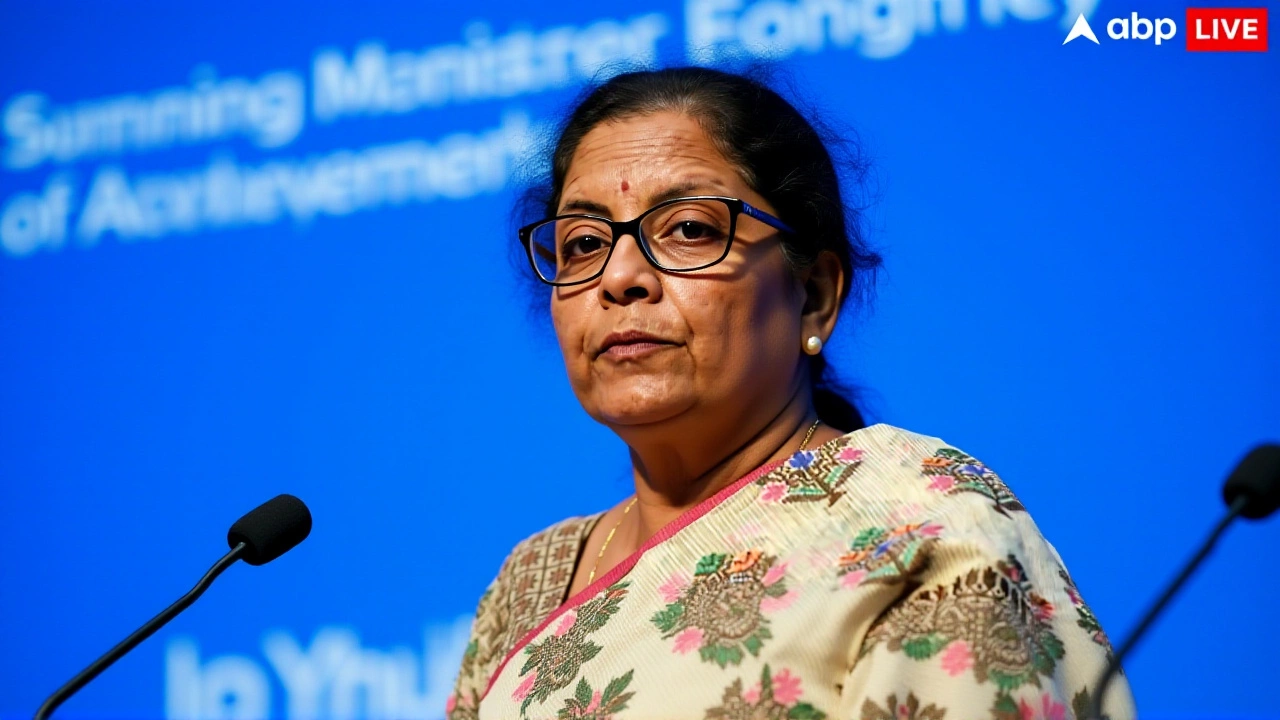
When Nirmala Sitharaman, Finance Minister of the Government of India, announced the latest round of tax cuts on petrol and diesel, she didn't sugarcoat the cost. The central government is set to lose approximately ₹1 lakh crore (about $12 billion) in revenue this fiscal year. It’s a massive number, sure, but here’s the twist: that money isn’t disappearing into thin air. It’s being redirected as relief for everyday commuters and businesses struggling with rising inflation.
The announcement came during a high-profile event in Mumbai, Maharashtra, at the 37th Foundation Day celebrations of the Small Industries Development Bank of India (SIDBI). While the headline figure grabs attention, the mechanics behind it reveal a careful balancing act between keeping the economy moving and keeping the treasury stable.
The Math Behind the Relief
Let’s break down what actually changed. For months, fuel prices had been creeping up, driven by global crude oil volatility and geopolitical tensions in West Asia. Since mid-May, consumers saw prices rise by about ₹7.50 per liter. To counter this, the government slashed the excise duty—a direct tax on manufactured goods—by roughly ₹10 per liter.
Specifically, the excise duty on petrol dropped from ₹21.90 to ₹11.90 per liter. Diesel saw an even steeper cut, with duties reduced significantly to ease the burden on logistics and transport sectors. But wait—here’s where it gets tricky for the average consumer. Despite these cuts at the wholesale level, retail prices at the pump haven’t necessarily plummeted overnight. State governments also levy VAT (Value Added Tax), which hasn’t changed uniformly across all states. So, while the federal tax burden is lighter, the final price you pay depends heavily on where you live.
Plugging the Revenue Hole
Losing ₹1 lakh crore is no small feat. That’s money that could have gone toward infrastructure projects or social welfare schemes. So, how is the government managing the shortfall? Enter the export duty strategy.
Central Board of Indirect Taxes and Customs (CBIC) Chairman Vivek Chaturvedi clarified the approach in recent interviews. The logic is straightforward: discourage exports of refined petroleum products to ensure adequate domestic supply, thereby stabilizing local prices. By imposing export taxes on diesel, the government aims to keep more fuel within India’s borders. Interestingly, no export duty has been placed on petrol yet, due to current "crack margins"—the profit difference between crude oil and refined products—which make petrol exports less lucrative right now.
Estimates suggest this export tax could generate around ₹1,500 crore over a two-week period. It’s a drop in the ocean compared to the ₹1 lakh crore loss, but it’s part of a broader strategy to manage cash flow without completely halting trade.
Monitoring the Impact
The details are still unclear regarding the long-term fiscal impact, but officials are watching closely. Vivek Chaturvedi mentioned that the revenue impact will be assessed every 15 days. This bi-weekly review cycle allows the finance ministry to tweak policies if the deficit widens unexpectedly or if global oil prices stabilize faster than anticipated.
Economists speaking to Business Today TV have warned that the annual loss could exceed the initial estimates, potentially hitting higher than ₹1 lakh crore when compounded over the full fiscal year 2026-27 (FY27). This discrepancy highlights the uncertainty inherent in volatile commodity markets.
Beyond Fuel: The MSME Connection
Why announce this at a SIDBI event? Because fuel costs directly hit Small, Medium, and Micro Enterprises (MSMEs) hardest. These businesses operate on thin margins; a spike in transport costs eats directly into their profits. During her address, Sitharaman emphasized payment discipline, urging larger corporations to settle dues with MSMEs within 45 days. The message was clear: reduce operational costs through fuel tax cuts, but also improve cash flow by ensuring timely payments. It’s a two-pronged attack on the financial stress facing India’s backbone industries.
What’s Next?
Consumers should expect continued vigilance from the finance ministry. If global crude prices remain elevated, further adjustments might be necessary. Conversely, if prices dip, the government may reconsider the extent of subsidies. For now, the focus remains on preventing a repeat of the severe inflationary spikes seen in previous years. The balance between taxpayer relief and fiscal responsibility is delicate, but the government is betting that keeping the wheels turning is worth the short-term revenue hit.
Frequently Asked Questions
Will petrol and diesel prices drop immediately at the pump?
Not necessarily. The cut applies to the central excise duty, but state governments impose their own Value Added Tax (VAT). Unless states also reduce their taxes, the retail price change may be minimal or delayed. Prices vary significantly across different Indian states due to these varying state-level taxes.
How much revenue is the government losing exactly?
Finance Minister Nirmala Sitharaman estimated the loss at approximately ₹1 lakh crore ($12 billion) for the current fiscal period. However, some economists warn that the actual annual loss could be higher depending on consumption rates and global oil price fluctuations throughout FY27.
Why is the government taxing diesel exports?
The export tax on diesel is designed to discourage sending refined fuel abroad, ensuring sufficient supply within India to meet domestic demand. This helps stabilize local prices. The government expects to recover about ₹1,500 crore from this measure in just two weeks, partially offsetting the excise duty losses.
How does this affect small businesses (MSMEs)?
Lower fuel costs reduce transportation and operational expenses for MSMEs, which often run on tight margins. Additionally, the Finance Minister linked this policy to better payment practices, urging large companies to pay MSME suppliers within 45 days to improve overall cash flow in the sector.